
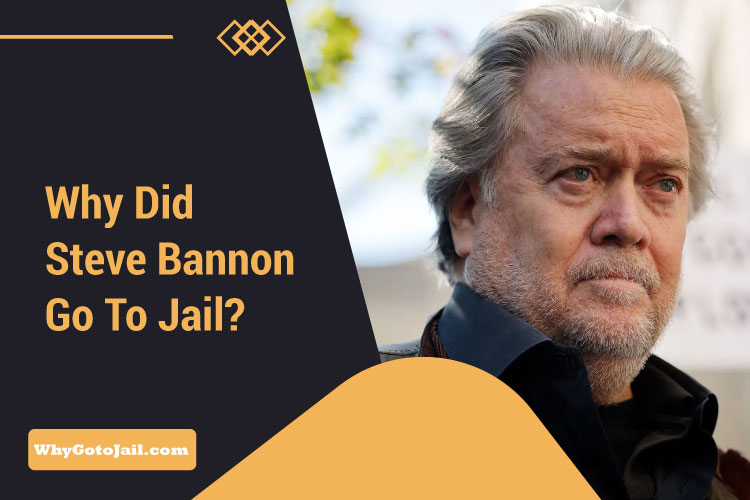
Steve Bannon, former White House chief strategist and a close friend of President Donald Trump, has been a controversial figure in American politics for quite some time. In addition to his influence on far-right media, Bannon is now widely recognized for his legal troubles and his role in igniting the MAGA movement.
One key topic has dominated the headlines following Steve Bannon’s recent jail sentence and court appearances: Why did Steve Bannon go to jail? This page outlines his legal background in clear language, step-by-step, up until the middle of 2025.
Contempt of Congress: The Beginning of Legal Trouble
The U.S. House Select Committee looking into the Capitol disturbance on January 6 subpoenaed Steve Bannon in September 2021. The committee asked him to testify and produce documentation detailing the events leading up to and during the violent attack.
Bannon had been out of government jobs for years at that point. He declined to assist, however, arguing that he was shielded by “executive privilege,” a legal defense employed by presidents and their immediate staff.
The House decided to hold him in contempt in October 2021. A few weeks later, in November, Bannon was charged with two crimes by the Department of Justice: refusing to testify and refusing to produce documents. His acts were viewed as a clear threat to the legislative branch’s legal power, in addition to being disrespectful to Congress.
The case went to trial in July 2022. He was found guilty on both charges by a jury. A federal judge then sentenced Bannon to four months in jail and a $6,500 fine in October of the same year. He did not, however, immediately go to jail. Through appeals, his legal team was able to postpone the beginning of his sentence for almost a year.
From Sentence to Jail: Timeline and Details
Steve Bannon eventually received an order to go to jail by July 1, 2024, following several delays and judicial denials, including one from the U.S. Supreme Court. He started his incarceration at Connecticut’s FCI Danbury, a low-security federal prison.
Even while incarcerated, Bannon continued to speak out. Claiming to be punished for resisting political pressure, he persisted in communicating via his podcast, “War Room.” While his detractors viewed his incarceration as a long-overdue punishment for breaking the law, his supporters viewed him as a political prisoner.
Bannon served his whole sentence and was released from jail on October 29, 2024. As the court had first mandated, he served precisely four months.
The ‘We Build the Wall’ Fraud Case: New Trouble in 2025
Before being sentenced to prison for contempt, Bannon had already been involved in another high-profile case. In this case, a fundraising initiative known as “We Build the Wall.” According to the initiative, private donations were being raised to assist with the construction of a wall along the U.S.-Mexico border. Thousands of contributors contributed more than $15 million to the campaign. As a member of its advisory board, Bannon was instrumental in its promotion.
But federal prosecutors accused Bannon and others of fraud in August 2020. Despite their assurance that all donor funds would be used for the building project, they said Bannon and his co-defendants misappropriated the funds for their benefit.
In January 2021, shortly before he left office, President Trump granted Bannon a complete pardon before the matter could proceed to trial. Although the pardon ended the federal prosecution, it did not shield him from state-level accusations.
In September 2022, Bannon was charged with new fraud under New York state law by the Manhattan District Attorney’s office. These included many felonies, including conspiracy, money laundering, and planning to deceive contributors. This time, Bannon had no protection since presidential pardons do not cover state-level offenses.
Guilty Plea and Conditional Discharge in 2025
Steve Bannon showed up in a New York state courthouse on February 11, 2025, and entered a guilty plea to a single felony charge: first-degree plot to defraud. He was spared more jail time as part of a plea deal. He was instead given a conditional discharge for three years.
Bannon is now free, but he has to abide by certain legal requirements or face more penalties. Among these conditions are:
- He cannot manage or raise money for any nonprofit or charity in New York.
- He is banned from using or selling donor lists gathered from the “We Build the Wall” campaign.
- He must remain free of any criminal activity during the three years.
New York prosecutors stated that donors had already received some restitution through other legal channels, so no financial penalties were added to the plea deal. Still, this conviction marked another major stain on Bannon’s record.
Timeline Summary of Bannon’s Legal Issues
| Date | Event |
| September 23, 2021 | Congressional subpoena issued |
| October 21, 2021 | The House votes contempt of Congress. |
| November 12, 2021 | DOJ indicts Bannon for criminal contempt |
| Jul 18–22, 2022 | Found guilty on 2 counts of contempt |
| October 21, 2022 | Sentenced to 4 months + $6,500 fines; stay pending appeal |
| May 10, 2024 | The appeals court affirms the conviction. |
| June 6, 2024 | Ordered to report by July 1, 2024 |
| July 1, 2024 | Begins prison term at FCI Danbury |
| October 29, 2024 | Released after serving a full term |
| February 11, 2025 | Pleads guilty in NY fraud case; receives 3-year conditional discharge |
Why This Matters in 2025
Even prominent political personalities face severe repercussions for disregarding Congress and deceiving funders, as seen in Steve Bannon’s legal issues. His case has come to represent broader discussions concerning political influence, transparency, and the rule of law in American democracy.
No one is above the law, as demonstrated by Bannon’s prison sentence, and his conviction for fraud demonstrated that state authorities would seek justice even in cases when pardons prevent federal action. Bannon, meanwhile, still has an impact on right-wing politics by appearing at political gatherings around the nation and producing a podcast every day.
Although his legal history may restrict his capacity to manage charity organizations or generate money, it hasn’t silenced his political voice. Critics view him as an example of corruption being held accountable at last, while many fans view his court battles as evidence that he is opposing the system.
Conclusion
In summary, Steve Bannon was guilty of contempt of Congress in 2024 for disobeying a court-issued subpoena. Later that year, he was freed after serving a four-month term. He avoided additional jail time in 2025 by entering a plea agreement and pleading guilty to state-level fraud charges about the “We Build the Wall” campaign.
Regardless of one’s position in the government or media, Bannon’s legal challenges demonstrate how political power may clash with the judicial system and the ensuing fallout. His narrative is about the expectations America has of people who will influence its future, not just of one individual.
Frequently Asked Questions
Did Steve Bannon go to jail?
Yes. In July 2024, he was sentenced to four months in federal jail for contempt of Congress.
What did Steve Bannon go to jail for?
During the January 6 probe, he was imprisoned for not responding to a congressional subpoena.
When does Steve Bannon go to jail?
He was freed on October 29, 2024, after being incarcerated since July 1, 2024.
Is Bannon still in legal trouble?
Due to a New York state fraud conviction, Bannon is now serving a three-year conditional discharge as of mid-2025. He is still being watched by the law, even if he is not in jail.