
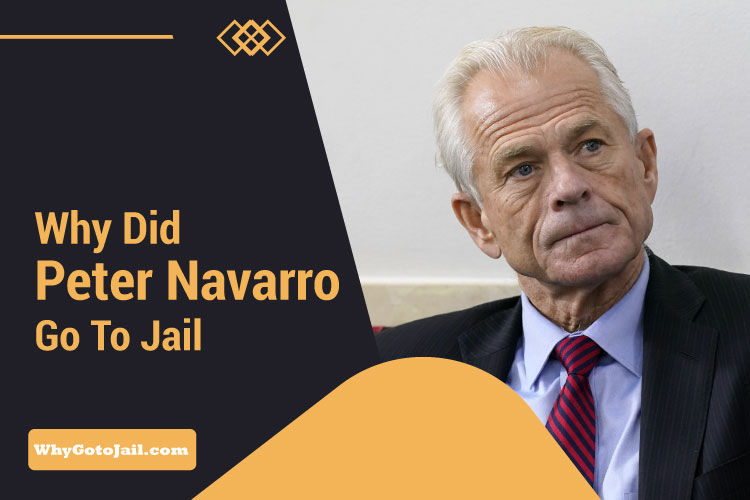
President Donald Trump’s former senior adviser Peter Navarro became one of the White House officials in the White House sentenced to federal prison in recent American political history. Once known for its fierce rhetoric on trade policy and epidemic strategy, Navarro now stands as a data center for the later legal collapse of Trump.
So, why did Peter Navarro go to jail? He was convicted of criminal contempt of Congress after refusing to comply with a subpoena issued by the House committee investigating the January 6 Capitol rebellion.
His conviction wasn’t approximately coverage variations or political disagreement; it turned into defying the rule of law. In this article, we take a deep look at how Navarro went from presidential advisor to inmate, the legal reasoning behind his sentencing, and what his case means for future political accountability.
Key Facts
- Peter Navarro was convicted of criminal contempt of Congress.
- He refused to testify about his role in the January 6 events.
- He refused to testify about his function within the January 6 activities.
- He was sentenced to 4 months in jail in 2024.
Peter Navarro’s Jail Case Overview
| Detail | Information |
| Full Name | Peter Kent Navarro |
| Position Held | White House Director of Trade and Manufacturing Policy (2017–2021) |
| Reason for Jail | Criminal contempt of Congress |
| Date of Conviction | September 7, 2023 |
| Sentence | 4 months in federal prison + $9,500 fine |
| Date Reported to Prison | March 19, 2024 |
| Prison Facility | Federal Correctional Institution (FCI) Miami |
| Related Investigation | U.S. House Select Committee on the January 6 Attack |
| Main Issue | Refusal to testify or submit documents |
Background: Who Is Peter Navarro?
Peter Navarro built his instructional and expert popularity as an economist, professor, and author. He entered the Trump administration in 2017 and quickly became one of the maximum vocal advocates of trade protectionism and financial nationalism. Navarro was recognized for its combat media performance and a radical attitude towards China.
By 2020, he had emerged as one of the main voices within the White House pandemic reaction group. But after the 2020 election, Navarro’s focus shifted dramatically. He commenced assisting and promoting false claims that the election had been stolen from Donald Trump, and he performed an energetic role in efforts to delay the certification of President Biden’s victory.
Navarro also wrote a report filled with voter fraud and later expanded a strategy known as “Green Bay Sweep” – a coordinated trial was made to challenge election results in large turning states. This located them without delay in the crosshairs of the House Committee that investigated the activities on January 6, 2021.
Subpoena and Refusal to Comply
In February 2022, the House Select Committee on the January 6 assault subpoenaed Peter Navarro. They requested that he testify and offer documents associated with his function in contesting the 2020 election and selling techniques to save you Joe Biden’s certification as president.
Navarro refused.
He didn’t just forget about the subpoena—he publicly boasted about his refusal, claiming he was shielded with the aid of executive privilege. Navarro argued that President Trump had instructed him no longer to testify and that he had no legal right to defy that order. However, Navarro never offered any formal documentation proving that Trump had invoked privilege on his behalf.
“They don’t have the right to compel me. The Constitution shields my communications with the president.” — Peter Navarro.
Why Did Peter Navarro Go to Jail?
Peter Navarro went to jail when he was convicted in two cases of criminal contempt of Congress. These claims arise from their conscious refusal to follow a legal achievement from the House Committee investigating the Capitol attack on January 6.
The two counts included:
- Count One: Failing to appear for a deposition.
- Count Two: Failing to produce subpoenaed documents.
In September 2023, Washington, D.C., after a small testing in, a federal jury found Navarro guilty in both cases. The judge sentenced him to 4 months in January 2024 with a fine of $ 9,500 in federal prison. On March 19, 2024, he informed FCI Miami, a federal reform plant with low protection in Florida, to initiate his judgment.
Unlike many defendants, who interact with petition agreements, Navarro remained until the end. He motivated the political claims and said he followed the orders.
Peter Navarro’s Path to Prison
| Date | Event |
| Feb 2022 | House January 6 Committee issues subpoena to Navarro |
| June 2022 | Indicted by a federal grand jury for contempt of Congress |
| Sept 7, 2023 | Convicted on two counts by a federal jury |
| Jan 2024 | Sentenced to 4 months in prison and fined $9,500 |
| March 19, 2024 | Reports to FCI Miami to begin serving sentence |
What Is Criminal Contempt of Congress?
Criminal contempt of Congress is a rarely used prison fee that penalizes those who willfully refuse to comply with congressional subpoenas. The regulation is designed to make sure that legislative investigations are taken seriously and that Congress keeps the energy to compel cooperation whilst necessary.
Under federal statute, each remember of contempt can bring up to one year in prison and fines. In Navarro’s case, prosecutors requested six months, but the decide opted for a four-month sentence.
This conviction serves as a reminder that ignoring a felony summons from Congress isn’t just political theatre—it’s a criminal act.
The Executive Privilege Defense—and Why It Failed
Navarro’s primary defense rested on executive privilege—the idea that he, as a former advisor, could not testify about conversations with the president. But this defense collapsed under legal scrutiny.
Here’s why it failed:
- No formal claim was filed by Trump invoking privilege in Navarro’s case.
- The former president (Biden) waived executive privilege for January 6 investigations.
- Courts ruled that Navarro couldn’t unilaterally decide not to appear.
- Even if privilege existed, he still had to appear and assert it during questioning.
“He didn’t even show up to say he couldn’t answer. That’s not how executive privilege works.”
— U.S. District Judge Amit Mehta
Political Reactions and Public Debate
Navarro’s sentence initiated sharp reactions on the political spectrum. Trump’s loyalists claimed that the case was a politically driven attempt to calm dissatisfaction. On the other hand, it saw it as a long-term moment of responsibility for those involved in the work of reversing democratic election results.
Some noted parallels with the Steve Bannon case—another Trump ally who was convicted of contempt for ignoring a congressional subpoena. (Read more about why Steve Bannon went to jail.
Peter Navarro vs Similar Legal Cases
| Person | Position in Government | Charges/Offense | Sentence | Relevance to Navarro’s Case |
| Peter Navarro | Trade Advisor under Trump | Criminal contempt of Congress | 4 months in prison | Refused to comply with the Jan 6 subpoena |
| Steve Bannon | Former Chief Strategist to Trump | Criminal contempt of Congress | 4 months in prison | Same charge; also defied the Jan 6 committee |
| Harriet Miers | Former White House Counsel | Ignored subpoena (2007, no prosecution) | None | Also claimed exec privilege, no jail |
| Eric Holder | Attorney General under Obama | Contempt of Congress (Fast & Furious) | None | Held in contempt, but not criminally |
| Michael Flynn | National Security Advisor | Lying to the FBI | Pleaded guilty | Different charge, but tied to the Trump era |
Conclusion
In conclusion, Peter Navarro went to prison due to the fact he refused to follow the regulation. He defied a congressional subpoena tied to one of the maximum extensive political investigations in latest U.S. History—the January 6 Capitol assault. His declare of executive privilege became unsupported, and the courtroom located him responsible of criminal contempt.
His case isn’t always just about one guy—it’s about maintaining the rule of regulation and ensuring that even powerful government officials are not above prison scrutiny. Navarro’s prison sentence sets a powerful precedent: ignoring Congress has outcomes.
FAQs
Why did Peter Navarro go to jail?
He turned into convicted of criminal contempt of Congress for refusing to comply with a subpoena issued by the House January 6 Committee.
What was Peter Navarro subpoenaed for?
He was called to testify and post documents about his role in efforts to put off or overturn the 2020 presidential election outcomes.
How long is Peter Navarro in jail for?
He was sentenced to 4 months in federal jail.
When did Peter Navarro report to prison?
He began serving his sentence on March 19, 2024.
Did the government privilege shield him?
No. Courts ruled his claim of government privilege was not legitimate and no longer exempted him from complying with the subpoena.